
Handmade in the Southern Highlands, NSW
Australian Perfume
Australian perfume, made by hand. Every scent is blended, filled and labelled in a one-person studio in Moss Vale, NSW. Unisex, small batch, and built to still be there at 5pm. Try any of them as a 10ml Traveller first.
Free shipping over $99-
Amber No. 235 – Lychee, Amberwood & Spun Sugar
Regular price From $35.00Regular price -
Apple No. 341 – Juicy Apple, Watermelon & Madagascar Vanilla
Regular price From $35.00Regular price -
Bergamot No. 353 – Calabrian Bergamot, Grapefruit & Petitgrain
Regular price From $35.00Regular price -
Cedarwood No. 443 – Cedarwood, Aged Patchouli & Basil
Regular price From $35.00Regular price -
Cinnamon No. 425 – Cinnamon Bark, Pink Pepper & Mahogany
Regular price From $35.00Regular price -
Desert Rose No. 209 – Desert Rose, Agarwood & Cashmere
Regular price From $35.00Regular price -
Fig No. 431 – Wild Fig, Sea Salt & Vetiver
Regular price From $35.00Regular price -
Honey No. 325 – Acacia Honey, White Peach & Wild Jasmine
Regular price From $35.00Regular price -
Neroli No. 437 – Fresh Peach, Sea Breeze & Neroli
Regular price From $35.00Regular price -
Orange Blossom No. 207 – French Rose, Zesty Yellow Ginger & Lily
Regular price From $35.00Regular price -
Oud No. 401 – Oudh Wood, Golden Amber & Leather
Regular price From $35.00Regular price -
Peony No. 211 – Lily of the Valley, Peony & Mandarin
Regular price From $35.00Regular price -
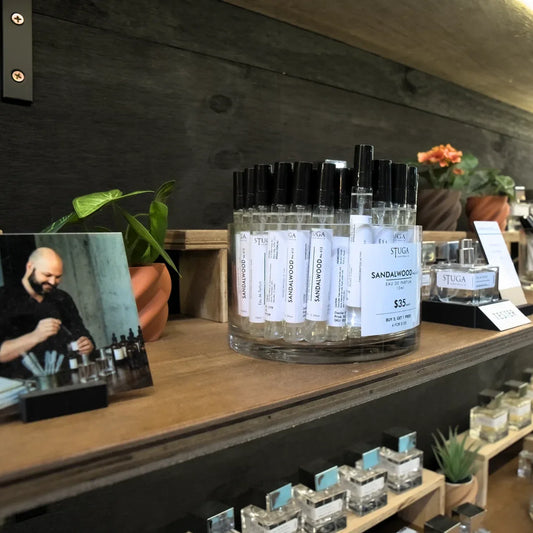
Sandalwood No. 413 – Sandalwood, Black Pepper & Lime Peel
Regular price From $35.00Regular price -
Tobacco Leaf No. 407 – Tobacco Leaf, Spiced Plum & Guaiac Wood
Regular price From $35.00Regular price -
Vanilla No. 313 – Sweet Passionfruit, Orange Zest & Vanilla Bean
Regular price From $35.00Regular price -
White Musk No. 421 – Silver Birch, Blackcurrant & White Musk
Regular price From $35.00Regular price -
White Tea No. 203 – Matcha, Yuzu & White Tea Leaves
Regular price From $35.00Regular price




The buyer's guide
Everything worth knowing before you choose.
Australian perfume — what's actually Australian about it
The blending, the filling and the labelling. Every bottle is made in Moss Vale in the Southern Highlands, by the same person who packs your order — not white-labelled, not imported and relabelled, not bottled from someone else's drum. It's made in small batches to order, so a 100ml is no older than a 10ml.
What we don't claim: that every material is grown here. Fragrance materials come from reputable suppliers around the world, the same as every perfume house in the country. "Australian" on this page means made here, by hand, and you can ask us anything about how.
Sizes run 10ml ($35), 30ml ($95), 50ml ($155) and 100ml ($300), all at the same strength, with Buy 3 Get 1 Free across the range. Free shipping over $99, posted from the studio.
Longer reads: the best Australian perfume in 2026, or how these are actually made.
Perfume or cologne — is there a difference here?
Not at Stuga. Cologne, eau de parfum, fragrance — those words describe strength and format, not who's allowed to wear it. If you came looking for a cologne rather than a perfume, they're the same bottle. The only word that means something is concentration, and everything here sits at 20–25%.
Nothing in the range is a men's cologne or a women's perfume; they're all blended without a gender in mind. The whole range gathered under that heading, with the picks that move most evenly across buyers, is here: unisex perfume.
If it helps to start somewhere narrower, Men's Cologne and Women's Perfume gather the scents each group reaches for most — doorways into the same range, not separate ranges.
Long lasting perfume — why these don't fade by lunch
Longevity is almost entirely concentration — how much fragrance oil is actually in the bottle, and nothing else you can see on a label tells you. An eau de toilette can be as low as 5%. Most designer eau de parfums sit between 15 and 20%. Everything here is blended at 20–25%.
That is the whole reason a Stuga scent is still there at 5pm. It is not a trick of the blend or a clever base note — there is simply more perfume in the bottle. It also means one or two sprays is the correct dose rather than a starting point.
Full explanation: why your perfume fades by lunch, or long lasting perfume in Australia.
Spray, alcohol-free or roll-on — same strength?
Yes. Each fragrance is available as a classic Eau de Parfum spray, an alcohol-free spray, or a roll-on perfume oil. Same composition and the same concentration across all of them — different carriers for different ways of wearing scent.
Read the format comparison if you're not sure which suits you.
What's in each scent family
The full range is a lot to scroll. Not sure which perfume is for you? Take the 30-second scent finder — two questions, no jargon — or start with the family that matches the kind of perfume you want to wear. If you'd rather understand why each one smells the way it does, read our guide to perfume notes and scent families.
- Woods — Sandalwood No. 413, White Musk No. 421, Cedarwood No. 443, Oud No. 401, Tobacco Leaf No. 407, Cinnamon No. 425, Fig No. 431. Sandalwood, silver birch, cedar, oud, tobacco, vetiver, mahogany.
- Floral — Peony No. 211, Orange Blossom No. 207, Desert Rose No. 209, Honey No. 325, White Tea No. 203. Jasmine, rose, peony, lily of the valley, white peach.
- Fresh — Neroli No. 437, White Tea No. 203, Bergamot No. 353, Fig No. 431, Apple No. 341. Sea breeze, white tea, matcha, grapefruit, wild fig.
- Amber & Spice — Oud No. 401, Amber No. 235, Desert Rose No. 209, Cinnamon No. 425, White Musk No. 421. Amber, oud, saffron, musk, cinnamon, clove.
- Vanilla & Sweet — Vanilla No. 313, Amber No. 235, Apple No. 341, Cinnamon No. 425. Passionfruit, orange zest, apple, spun sugar, cinnamon, vanilla.
Finding a signature scent
A signature scent is the one you stop deciding about — the bottle you reach for without thinking, and the one people start associating with you. Most people arrive at theirs by accident. It's worth doing on purpose.
Two things make a scent stick. The first is that it works across seasons, which is why woods and soft ambers become signatures more often than heavy gourmands or bright citrus. The second is that it lasts — a scent nobody smells on you after 11am never becomes anyone's signature.
The honest way to find one is to live with a few candidates rather than sniff twenty on card in a shop. Buy a 10ml Traveller of two or three, wear each for a week, and notice which one you miss. Our perfumes, ranked is a reasonable shortlist to start from, and it's honest about which ones aren't for everyone.
Can I try a scent before committing to a full bottle?
Every scent is available as a 10ml Traveller — a full-strength spray bottle, enough for two to three weeks of daily wear, and enough to know whether it's yours before you buy a full 50ml. A practical way to try handmade Australian perfume without the blind-buy risk.
Natural perfume — what that actually means
“Natural” gets used loosely in fragrance, so here is the honest version rather than the marketing one.
Every Stuga perfume is vegan and cruelty-free, with no animal-derived musks, ambergris or fixatives — the materials that traditionally made perfume anything but.
What it isn't: a claim that every molecule is plant-derived. Modern perfumery uses synthetics because some of the best materials cannot be extracted from a plant at all, and because the natural alternatives to several of them are ecologically ruinous. Anyone selling you an entirely natural perfume at this price is either mistaken or counting on you not asking.
Longer read: how these are actually made.
How strong is it, and how is it made?
Every Stuga fragrance is hand-blended in small batches in the Southern Highlands at 20–25% concentration — roughly twice the strength of most designer eau de parfums. That is why a little goes further than you're used to, and why it stays on skin rather than fading by lunchtime.
Vegan, cruelty-free, small batch. Handmade in the Southern Highlands with fragrance notes sourced from across the world.